
CEHD - About Us
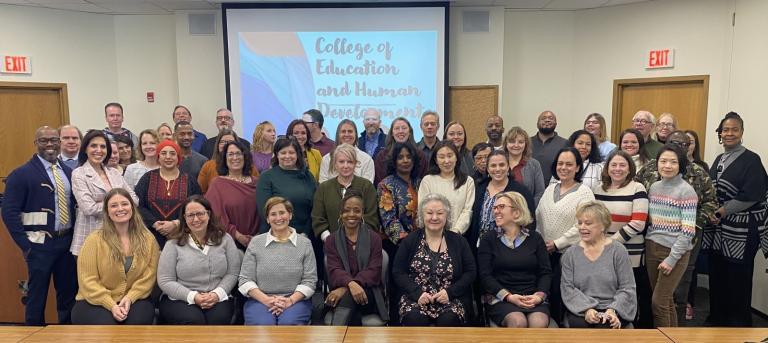
The College of Education and Human Development (CEHD) has two academic divisions, the Division of Education and Leadership (DEL) and the Division of Psychology and Counseling (P&C).
It is also home to the Family Development Center (FDC), Community Counseling Services, the Psychology and Counseling Research Lab, and the Lit Zone.
CEHD Mission
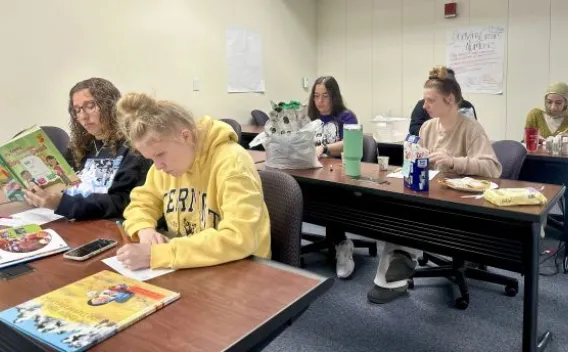
The College of Education and Human Development prepares its students to be reflective lifelong learners; advocates for diversity and social justice; and engaged, effective, transformative educators and mental health professionals.
Vision
The College of Education and Human Development will be a recognized regional leader in the preparation and ongoing development of educators and of mental health professionals. The College will be especially acclaimed for its leadership in the following areas:
- Performance-based assessment practices
- Field-based and clinical practice
- Evidence-based process improvement
- Achievements in teaching, scholarship, research and service

Core Values
- Education sustains democracy.
- Education provides powers of concentration and worthy objectives upon which to concentrate.
- Education is a life-long journey worth the effort.
- It is our professional responsibility to create and maintain a learning environment that builds up the human spirit, both socially and intellectually.
- We remake the world when we share our intellectual ideals, model ethical standards, embrace human diversity, and engage in civil and professional service.
The Professional Education Unit
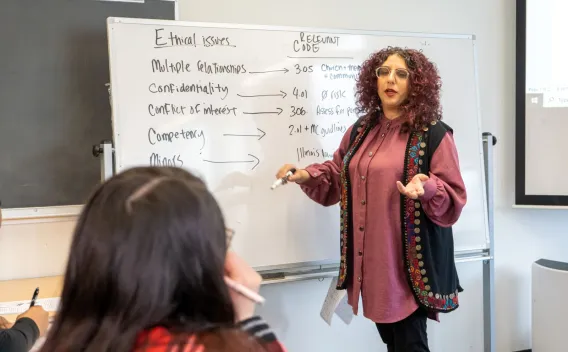
The professional education unit seeks to offer the highest quality academic programs, balancing innovation and best practice, to meet the needs of lifelong learners. The faculty, staff and administration are committed to seeking and maintaining national accreditation of the unit and its programs, enhancing existing programs as well as creating new programs including doctoral studies. We integrate the wide-spread use of technology into curricula, content and modes of instruction. Together, we foster an understanding and appreciation of the significance of human diversity in ethnicity, socioeconomic status, gender and learning styles.
Conceptual Framework
Reasoned eclecticism, the harmonizing element in all the unit's activities, emerges from the unit's emphasis on the development of competent practitioners who operate at high cognitive levels, and who attend primarily to application and testing of knowledge (rather than to theoretical orthodoxy.)
Increasing attention on performance assessment asks teacher educators to redirect their focus from the theoretical into the teaching/learning environment where theory and practice meet. The unit believes that reasoned eclecticism produces desirable results and outcomes more frequently than any single, more purely theoretical approach.
A vital characteristic of the successful reasoned eclectic practitioner is a high level of cognitive development and operation. The unit is committed to moving candidates from lower pre-conventional levels of cognitive complexity to higher post-conventional cognitive levels in order to optimize their application of reasoned eclecticism. Graduates at higher stages have the knowledge, skills and dispositions to change the learning environment in accord with the diverse needs of diverse students.
The professional education unit is dedicated to the development of knowledge, skills and professional dispositions of GovState candidates through reflective analysis and guided inquiry to optimize student learning.
Summary of Candidate/Graduate Outcomes
The Educator Preparation Program prides itself on preparing excellent educators to serve our schools and communities. Whether as a classroom teacher, school service personnel or administrator, the success of our candidates impacts the world around us.
Visit the Illinois Educator Preparation Profiles available for the following initial licensure programs:
- Early Childhood Education
- Elementary Education
- Secondary Education, English Language Arts
- Secondary Education, Mathematics
- Secondary Education, Biology
- Secondary Education, Chemistry
- Learning Behavior Specialist I (LBS I), Multicategorical Special Education
Please click here to see the First-Year Teacher Administrator Feedback Survey Report, Three-Year Trends.
School District Partners
GovState places candidates in cities, suburbs and rural communities throughout the region. Click here for a list of host sites and partner districts.
Contact Us
CEHD Dean’s Office
708-534-4050
cehd@govst.edu
Office: G258
Hours: Monday - Friday, 8:30 a.m. to 5 p.m.
Interested in a CEHD program?
- Contact Jackie Ramirez
- 708-534-6979
- jramirez8@govst.edu