
Communication Disorders, B.H.S.
Are you passionate about helping people learn to speak and communicate effectively? A bachelors degree in Communication Disorders is the first step toward admission to graduate program and becoming a licensed speech-language pathologist. Use your passion and your skills to assist individuals in nearby Chicago or anywhere in the world you may launch a career after your time at GovState.
What can you expect from being a student of the Communication Disorders program?
Our location in Chicago’s Southland offers unique pre-clinical experiences that will prepare you for a certification program and graduate study. You will work closely with highly qualified faculty, thanks to our small class sizes and faculty mentorship opportunities. If you have questions about the best way to become a speech-language pathologist, an undergraduate advisor and the CDIS undergraduate program director will work with you to determine the courses and next steps to take.
The Chicago Southland offers many pre-clinical and observation experiences for your coursework. While the small size of our campus aids in instruction, our proximity to Chicago allows you to observe experienced master clinicians in speech-language pathology and professionals in other related health professions.
Quick Facts
General Education Requirements:
37 – 41 hours
Core Requirements: 54 hours
Electives: 25 – 29 hours
Total: 120 hours
Reach Your Career Goals
As a speech-language pathologist (SLP), your job will be to evaluate a speech, language, or swallowing difficulty, explore treatment options, and prepare a treatment plan for your client. A day in your life of as an SLP might include daily therapy sessions, parent or clinical team meetings, or discussing a client's treatment plan to be facilitated by a teacher, social worker, or other professional.
As a BHS student in Communication Disorders at GovState, you must develop a solid foundation in biological, and physical sciences. This foundation will help you understand the underpinnings of typical and unusual cases and how to solve problems for accurate diagnosis of a speech or language disorder. At the graduate level, you’ll enjoy hands-on experience with clients in a variety of settings creating treatment plans and practicing treatment options.
As a future Speech-Language Pathologist, you will empower clients of all ages through an improved ability to communicate. Employment for speech-language pathologists is expected to grow by 18% over the next decade (Bureau of Labor Statistics).
During didactic coursework, undergraduate Communication Disorders students engage in many practical, real-life activities that help them prepare for graduate school. Once in graduate school, students participate in internal practicum experiences supervised by CDIS faculty and full-time external practicum experiences.
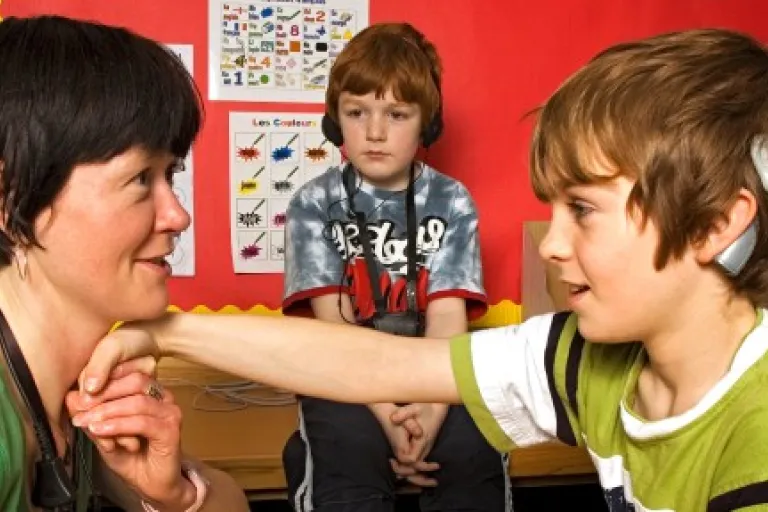
A Strong Foundation for a Demanding Career
A speech-language pathologist's career is demanding. The Bachelor of Health Science in Communication Disorders program builds the strong foundation you'll need to succeed in the Master of Health Science in Communication Disorders program — which is your gateway to the profession. We take you from the very basics, from Phonetics to Language Development, and we build on your knowledge to bring you to more advanced concepts.
The range of subject matter is far-reaching because speech-language pathologists must draw upon a wide knowledge base to understand their clients and help them improve. The BHS curriculum will prepare you to deal with issues of grammar, as well as psychology. You’ll learn anatomy, physiology, and neurosciences. And you’ll discover the foundations of education. The BHS will give you everything you need to advance into a Master’s program and successfully complete your path to a career as a speech-language pathologist.
Degree Requirements - Bachelor of Health Science in Communication Disorders
A bachelor's degree in Communication Disorders is required preparation for the Master in Health Science in Communication Disorders degree, the entry-level degree for the profession.
Many students in the College of Health and Human Services are working adults. Because undergraduate courses in Communication Disorders are offered twice each year, there is great flexibility when scheduling courses. Students can attend either on a part-time or full-time basis.
General Education Requirement for the School Service Personnel Certificate: 37 to 41 semester credits. Students intending to apply for the School Service Personnel Certificate, Type 73, must meet the University General Education Requirements (see catalog for requirements).
The following courses or their equivalents may be taken at either the lower-division or upper-division level:
Required Courses (54 Hours)
CDIS 2100 Introduction to Sign Language (3)
CDIS 3099 Introduction to Communication Disorders (3)
CDIS 3400 Phonetics (3)
CDIS 3500 Speech and Hearing Science (3)
CDIS 3600 Anatomy and Physiology of Speech and Hearing (3)
CDIS 4100 Language Development: Early Stages (3)
CDIS 4150 Language Development: Later Stages (3)
CDIS 4200 Sociolinguistics (3)
CDIS 4300 Neuroscience for the Study of Communication Disorders (3)
CDIS 4400 Introduction to Audiology (3)
CDIS 4600 Augmentative and Alternative Communication (3)
CDIS 4900 Intro to Assessment and Intervention (3)
CDIS 4901 Intro to Assessment and Intervention Lab (1) (Co-requisite to CDIS 4900) MATH 2100 Elementary Statistics (3)
PSYC 3201 Child Development (3)
PSYC 3201 Principles of Psychology (3)
SPED 2100 Survey of Students with Exceptionalities (3)
Language Proficiency
In cases where students use non-standard English because English is their second language or second dialect, the Communication Disorders Department faculty will adhere to ASHA’s position statement, Students and Professionals Who Speak English with Accents and Nonstandard Dialects.
"It is the position of the American Speech-Language-Hearing Association (ASHA) that students and professionals in communication sciences and disorders who speak with accents and/or dialects can effectively provide speech, language, and audiological services to persons with communication disorders as long as they have the expected level of knowledge in normal and disordered communication, the expected level of diagnostic and clinical case management skills, and if modeling is necessary, can model the target phoneme, grammatical feature, or other aspects of speech and language that characterizes the client's particular problem. All individuals speak with an accent and/or dialect; thus, the nonacceptance of individuals into higher education programs or professions solely based on the presence of an accent or dialect is discriminatory. Members of ASHA must not discriminate against persons who speak with an accent and/or dialect in educational programs, employment, or service delivery, and should encourage an understanding of linguistic differences among consumers and the general population."
American Speech-Language-Hearing Association. (1998). Students and Professionals Who Speak English With Accents and Nonstandard Dialects: Issues and Recommendations [Position Statement]. Available at http://www.asha.org/docs/html/PS1998-00117.html
GovState Chapter of NSSLHA
Governors State University has a local chapter of the National Student Speech Language Hearing Association (NSSLHA-GovState).
The National Student Speech Language Hearing Association is a pre-professional membership association for students interested in the study of communication sciences and disorders. National membership is available to undergraduate, graduate, or doctoral students enrolled full- or part-time in a communication sciences program or related major. For more information, please visit the NSSHLA website.
The purposes of this organization are to:
- Promote a feeling of belonging for students in communication disorders;
- Foster communication between students and faculty; and
- Expose students to relevant experiences they would not get in classrooms or clinical practicums.
Yearly dues currently are $10.
Click below to download the CDIS Strategic Plan:
What You'll Study
Our academic catalog has detailed information about what you'll study, like courses, hours needed for completion, and other requirements.
How to Apply
You'll need certain documents and meet certain requirements in order to apply. Read about them on our admissions pages.
Financial Aid and Scholarships
Governors State’s mission is to offer accessible and exceptional education, which is why GovState offers the most affordable tuition rates in the Chicagoland area—all while maintaining our top accreditations.
As a student at Governors State University, you have many available ways to cover the cost of your tuition.
University Lecturer and Undergraduate Program Coordinator in the Communication Disorders
- Elaine Reyna
- College of Health and Human Services
- 1 University Parkway, University Park,IL, 60484-0975
- 708-235-7535
- ereyna@govst.edu